

This spirometry report came across my desk today.
Obs: %Pred: Pred:
FVC (L): 5.14 101% 5.10
FEV1(L): 4.07 105% 4.07
FEV1/FVC: 79 104% 76
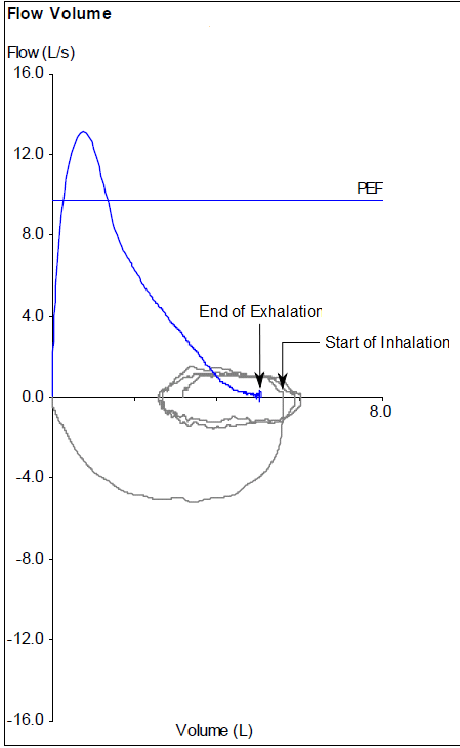
On the face of it, this looks like an eminently normal spirometry test. If you look carefully at the flow-volume loop however, you will see that the inhaled volume is greater than the exhaled volume. The test system did not report the inspiratory vital capacity (FIVC) but by eyeball I would estimate the difference to be about 0.60 liters. The ATS recommends that the largest vital capacity, regardless of where it comes from should be used to calculate the FEV1/VC ratio. This means that the FEV1/FIVC ratio is actually about 70.9 not 79.2 which is 93% of predicted, not 104% and that this is probably mild airway obstruction.
This spirometry effort met all ATS/ERS criteria. It was longer than 6 seconds and met end-of-exhalation flow rate criteria. Is this gas trapping? Given the FEV1, probably not in the same way that somebody with COPD might have gas trapping, but maybe yes. The patient was 68 years old and since closing volume rises with age a certain amount of gas trapping is a normal consequence of aging and I think this may be what this spirometry effort is showing. Or, despite meeting end-of-exhalation criteria maybe the patient should have exhaled longer.
This spirometry effort also got me curious about why the test system did not report the FIVC. The PFT Lab I am associated with does not normally report FIVC. For those patients whose inspiratory flows are important we tend to look solely at the contour of the flow-volume loop and not at any specific inspiratory flow rate numbers or ratios. There were no settings in the software for FIVC and the test system’s manual did not address this issue at all so with some simple experimentation I found that it would report an FIVC only if the inspiratory effort was performed immediately following the FVC effort.
This is a point of some concern because the ATS/ERS statement on spirometry says you can perform an FIVC maneuver either before or after a forced expiratory effort and that as already mentioned the largest VC should be used for the FEV1/VC ratio. Because the software for our testing system (and I suspect many other test systems) only allows the FIVC to be measured after the FVC it is missing, at least in those cases like this one, an accurate assessment of the patient’s largest VC.
In addition, from a procedural point of view I suspect that some patients may be able to exhale further towards RV and therefore produce a larger inspiratory vital capacity when the exhalation starts with a steady exhalation from FRC than immediately after a prolonged forced expiratory effort and our test system will not allow FIVC to be measured this way.
Strictly speaking, forced inspiratory flow rates and vital capacity are not values that normally need to be measured. Inspiratory airway obstruction is much less common than expiratory airway obstruction and in addition my experience has been that patient inspiratory efforts tend to be far more variable and irreproducible than expiratory efforts. This particular spirometry effort was unusual in that the reported values were essentially normal and this kind of discrepancy between inspiratory and expiratory vital capacity is something that is more commonly seen with moderate to severe COPD.
References:
Miller MR, et al. ATS/ERS Task Force: Standardization of Spirometry. Eur Respir J 2005; 26: 319-338.
Pellegrino R, et al. ATS/ERS Task Force: Interpretive strategies for lung function tests. Eur Respir J 2005; 26: 948-968.

PFT Blog by Richard Johnston is licensed under a Creative Commons Attribution-NonCommercial 4.0 International License.