

I was reviewing a cardiopulmonary exercise test (CPET) recently. The test was part of a pre-op workup for a patient with lung cancer who also had a diagnosis of COPD. I had looked at the spirometry results first (we always do spirometry pre- and post-exercise) and seeing that the patient had severe airway obstruction (FEV1 < 50% of predicted) assumed the review would be relatively straightforward. I then saw just one exercise test value and knew immediately that this wasn’t going to be an ordinary test. That test value was the PETCO2 at anaerobic threshold, which happened to be 40.
There are a number of CO2-related values that are useful when assessing exercise test results. Although End-tidal CO2 (ETCO2) is not a quantitative measurement in the same sense that minute ventilation or oxygen consumption is, it is still able to provide a lot of useful information about ventilatory efficiency and disease states.
ETCO2 is related in various degrees to tidal volume, respiratory rate, the deadspace to tidal volume ratio (Vd/Vt) and CO2 production. There is a correlation between PETCO2 and both alveolar CO2 (PACO2) and arterial CO2 (PaCO2) however the correspondance is far from exact or predictable. Alveolar CO2 fluctuates cyclically with ventilation and since Vd/Vt is never zero PETCO2 is always higher than the average PACO2. Numerous investigators have developed algorithms that correlate PETCO2 with arterial CO2 but during exercise PETCO2 can be well below PaCO2 because of ventilatory inefficiency or it increase well above PaCO2 because it can become dominated by mixed-venous PCO2.
When there is a mismatch between ventilation and perfusion, ventilation has to increase in order to maintain the same level of gas exchange. Ventilation-perfusion mismatching and an exaggerated ventilatory response to exercise is a common features in diseases as different as COPD, pulmonary hypertension and ventricular failure. When ventilation is increased relative to CO2 production during exercise this fact shows up in the Ve-VCO2 slope, the mixed-expired CO2 (PECO2) and the PETCO2.
PETCO2 should be evaluated in terms of its maximum observed value and in its overall pattern during and following exercise. The maximum PETCO2 usually occurs at or near anaerobic threshold and the lower limit of normal is around 35 mm Hg. The maximum PETCO2 is reduced below 35 in both cardiac and pulmonary disease and the amount of reduction tends to correlate well with the severity of the disease.
This by itself is what told me that despite the reduced FEV1 and the diagnosis of COPD, with a PETCO2 of 40 at anaerobic threshold the patient probably had normal gas exchange. We do not routinely do diffusion capacity testing as part of a cardiopulmonary exercise test so that part will have to remain speculative. When the Ve-VCO2 slope was calculated however, it was 28, which is well within normal limits. Most COPD patients we see for CPETs have a PETCO2 of 30 or less and Ve-VCO2 slopes greater than 40.
The overall pattern of the patient’s PETCO2 during exercise was also wrong for COPD. The PETCO2 pattern that normal patients show during a CPET is to start off with a relatively low PETCO2. The PETCO2 then increases to its maximum value (usually at AT) and then decreases to peak exercise.
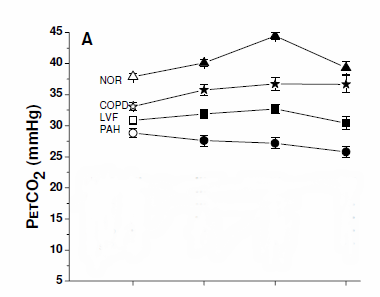
From: Hansen JE, Ulubay G, Chow BF, Sun X-G, Wasserman K. Mixed-expired and end-tidal CO2 distinguishes between ventilation and perfusion defects during exercise testing in patients with lung and heart diseases. Chest 2007; 132: 977-983.]
Patients with cardiac disease show a similar pattern to normal patients with the exception that the maximum PETCO2 is reduced below 35 and the degree of reduction correlates well with the NYHA stage of cardiac disease.
Patients with pulmonary hypertension however, show a distinctly different pattern where PETCO2 declines throughout testing and if anaerobic threshold is attained, the PETCO2 at that time is not the maximum PETCO2.
COPD patients also tend to have distinct pattern, that is pretty much the opposite of pulmonary hypertension. For COPD patients PETCO2 tends to rise throughout testing. Again if there is an anaerobic threshold, the PETCO2 at that time also tends not to be the maximum PETCO2.
The patient had a distinctly normal PETCO2 pattern and despite the low FEV1 and some dynamic hyperinflation (end-expiratory lung volume increased by 0.45 L) did not end up being limited by their ventilation (maximum minute ventilation was 70% of predicted and their Vt/IC ratio was 0.80). The patient stopped exercise because of leg fatigue but had reached 98% of their predicted maximum heart rate. The final summary was that there was a primarily cardiovascular limitation, most likely due to a low stroke volume (elevated chronotropic index and reduced maximum O2 pulse).
Now, having said all this, in this case what the normal PETCO2 at AT and normal PETCO pattern during exercise did was to alert us to the fact the patient was not going to have CPET typical of a patient with pure COPD. COPD patients tend to have both a pulmonary mechanical limitation because of their airway obstruction and a pulmonary vascular (gas exchange) limitation and it’s usually matter of determining which these two factors is the primary limitation. For this patient whatever gas exchange limitation they had was in a distant second place. This would have shown up eventually from the Ve-VCO2 slope if nothing else, but the PETCO2 at AT told me this immediately.
PETCO2 is most useful as an indicator. You can’t take the PETCO2 at AT or the PETCO2 pattern during exercise and predict what the CO2 production, the Vd/Vt or the minute ventilation are going to be. PETCO2 however, is easy to measure and to monitor during exercise and can alert you to a potential diagnosis well before the final results are available.
References:
Bussoti M, Magri D, Previtali E, Farina S, Torri A, Matturri M, Agostini P. End-tidal pressure of CO2 and exercise performance in healthy subjects. Eur J Appl Physiol 2008; DOI 10.1007/s00421-008-0773-z
Chambers JB, Kiff PJ, Gardner WN, Jackson G, Bass C. Value of measuring end tidal partial pressure of carbon dioxide as an adjunct to treadmill exercise testing. Brit Med J 1988; 296: 1281-1285.
Hansen JE, Ulubay G, Chow BF, Sun X-G, Wasserman K. Mixed-expired and end-tidal CO2 distinguishes between ventilation and perfusion defects during exercise testing in patients with lung and heart diseases. Chest 2007; 132: 977-983.
Liu Z, vargas F, Stansbury D, Sasse SA, Light RW. Comparison o the end-tidal arterial PCO2 gradient during exercise in normal subjects and in patients with severe COPD. Chest 1995; 107: 1218-1224.
Matsumoto A, Itoh H, Eto Y, Kobayashi T, Kato M, Omata M, Watanabe H, Kato K, Momomura S. End-tidal CO2 pressure decreases during exercise in cardiac patients. Association with severity of heart failure and cardiac output reserve. J Amer Coll Card 2000; (36)1: 242-249.
Myers J, Gujja P, Neelagaru S, Hus L, Vittorio T, Jackson-Nelson T, Burkhoff D. End-tidal CO2 pressure and cardiac performance during exercise in heart failure. Med Sci Sports Exerc 2009; 41(1): 18-24.
Yasunobu Y, Oudiz RJ, Sun X-G, Hansen JE, Wasserman K. End-tidal PCO2 abnormality and exercise limitation in patients with primary pulmonary hypertension. Chest 2005; 127: 1637-1646.

PFT Blog by Richard Johnston is licensed under a Creative Commons Attribution-NonCommercial 4.0 International License