

Many years ago I used to think that lung volume measurements were the easy part of PFTs. As time has gone on I’ve seen that getting accurate lung volume measurements is actually more difficult than getting accurate spirometry and DLCO results mostly because the errors tend to be subtle.
The errors that occur in lung volume measurements tend to cause an overestimation of lung volumes. This often means that restrictive diseases can be unrecognized or that hyperinflation and gas trapping can be diagnosed where it does not exist.
I see questionable lung volume test results more often than I’d like even from experienced technicians. When I find what went wrong I try to use these as “teachable moments” for all the the lab staff. Despite this the number of questionable test results never seems to drop below a certain level. I’d much prefer the error level was zero but since this is a situation that involves humans making measurements on humans I am likely being overly optimistic. A more realistic goal is to ask that the testing systems be smarter.
For at least the last 30 years there has been a industry-wide movement towards more automation in testing. The last time that I remember when you could buy a pulmonary function testing system that did not require a computer was the early 1980’s. This upside of this is that I can test a lot more patients more accurately and in less time with computer assistance than I could without it. The downside is that too many people believe that results are accurate because “that’s what the computer said”.
One of the most powerful aspects of computer software is that it can leverage expertise. Despite the dominence of computerized pulmonary function testing however, I have seen little increase in expertise. Routine testing errors that I first saw in computerized systems well over 20 years ago are still present. Here are two examples:
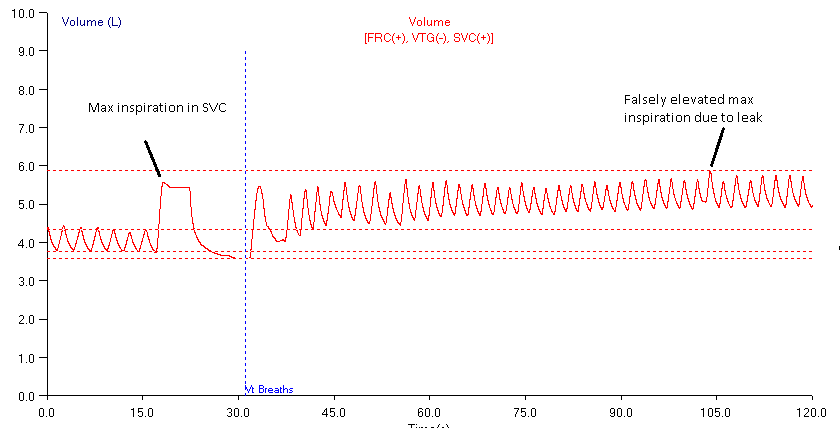
N2 Washout drift and SVC volume error
The procedure for the nitrogen washout test is for the patient to breath tidally for a period and then perform a slow vital capacity (SVC) maneuver. At maximal exhalation (RV) valves in the patient manifold are triggered, switching the patient to 100% oxygen as they resume tidal breathing. When the exhaled nitrogen level reaches a certain minimum level the test is completed. Here, there is a patient leak during testing and the post-SVC tidal breathing volume drifts upwards. When the computer analyzes the test results it overlooks two significant errors. First, it fails to recognize that the drift in the post-SVC tidal breathing indicates a leak which causes RV to be overestimated. Second, instead of measuring the maximal inspiration from where the SVC was performed, it takes it from the maximum of the post-SVC tidal breathing which causes SVC to be overestimated. Since TLC = RV+SVC, TLC is then markedly overestimated.
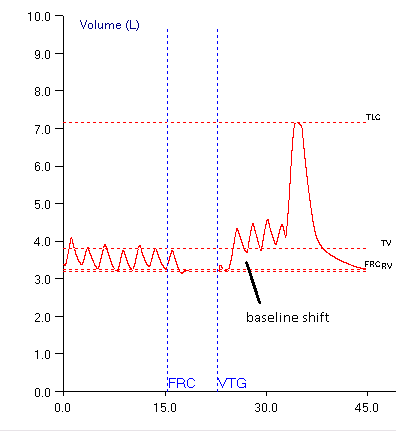
FRC baseline shift while shutter was closed
The procedure for plethysmography is for the patient to breath tidally for a period. This period is used to determine the volume level of the patient’s FRC. At end-exhalation a shutter interrupter closes (optimally at FRC) and the patient pants for a short period of time. While the shutter is closed the patient’s mouth pressure and the plethysmograph’s box pressure are measured and used to compute thoracic gas volume (TGV). When the shutter opens, the patient resumes tidal breathing and then performs a slow vital capacity maneuver. When the computer analyzes this test, it fails to recognize that the patient leaked while the shutter was closed which in turn caused the volume baseline for the SVC test to shift upwards. This causes the Inspiratory Capacity (IC) to be overestimated and since TLC = FRC+IC and RV = TLC – SVC, both TLC and RV are overestimated.
I have mixed feelings about calling for the manufacturers of test equipment to make their test systems smarter because I believe that technicians have a responsibility to understand the limitations of the equipment and the tests they perform. But since test equipment has become quite complicated and even trained and experienced technicians let these kind of errors pass through to a report, then it is evident that smarter software that at least warns that certain errors may be occurring would be helpful.

PFT Blog by Richard Johnston is licensed under a Creative Commons Attribution-NonCommercial 4.0 International License.