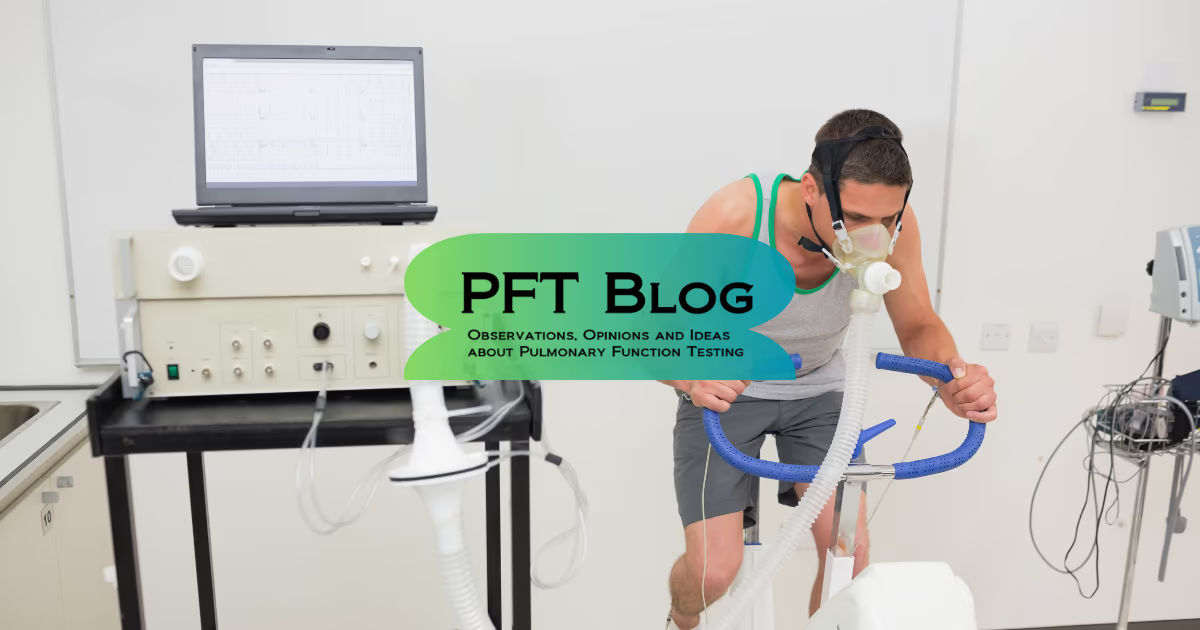
CPET Test Interpretation, Part 4: Interpretation and Summary
After having gone through the descriptive checklists for ventilatory, gas exchange and circulatory limitations the reason(s) for a patient’s exercise limitation, if any, should be reasonably clear. However, one of the first questions that should be asked when reading an exercise test is what was the purpose of the test? Maximum safe exercise capacity for Pulmonary Rehab? Rule in/rule out exercise-induced bronchospasm? Pre-operative assessment? Dyspnea of uncertain etiology? What is the primary limitation to exercise (pulmonary or cardiac)? Is deconditioning suspected? The interpretation and summary should address these concerns.
06 Nov 2019 06 November 2019 by [Richard Johnson] • 0 comments

2019 ATS/ERS Spirometry Standards
The 2019 ATS/ERS Spirometry Standards were recently released. The standards are open-access and can be downloaded without charge from the October 15 th issue of the American Journal of Respiratory and Critical Care Medicine. Supplements are available from the same web page. The 2019 Spirometry Standards have been extensively re-organized with numerous updates. Notably, a number of sections that were previously discussed in the 2005 General Considerations for Lung Function Testing have been updated and included in the 2019 Spirometry Standards. Also notably, a number of stand-alone spirometry tests, including the Flow-Volume Loop, PEF and MVV are not included in the 2019 Standards.
30 Oct 2019 30 October 2019 by [Richard Johnson] • 0 comments
CPET Test Interpretation, Part 3: Circulation
I would like to re-emphasize the importance of the descriptive part of CPET interpretation. At the very least consider it to be a checklist that should always be reviewed even when you think you know what the final interpretation is going to be. After gas exchange, the next step in the flow of gases is circulation. The descriptive elements for assessing circulation are: What was the maximum heart rate?
23 Oct 2019 23 October 2019 by [Richard Johnson] • 0 comments
CPET Test Interpretation, Part 2: Gas Exchange
I would like to re-iterate the importance of the descriptive part of CPET interpretation. At the very least consider it to be a checklist that should always be reviewed even when you think you know what the final interpretation is going to be. After ventilation, the next step in the flow of gases is gas exchange. The descriptive elements for assessing gas exchange are: What was the maximum oxygen consumption (VO2)?
16 Oct 2019 16 October 2019 by [Richard Johnson] • 0 comments
CPET Test Interpretation, Part 1: Ventilatory response
I’ve always found interpreting CPET tests to be one of the more interesting (and enjoyable) things I’ve done. Interpreting a CPET test is both more difficult and easier than interpreting regular PFTs. More difficult because there are a lot more parameters involved and easier because determining test adequacy and the primary cause(s) of an exercise limitation tends to be clearer. I’ve found that you have to go back to basic physiology whenever you interpret CPETs and that always boils down to the flow of oxygen and carbon dioxide.
09 Oct 2019 09 October 2019 by [Richard Johnson] • 0 comments

Sharing opinions with Paul Enright
Dr. Paul Enright is a well-known name in the field of Pulmonary Function testing. He is the lead author or co-author of over a hundred articles and has served on many of the ATS/ERS standards committees. Introduction: We both retired in southern Arizona and live a couple of towns apart from each other. We have corresponded for a while but met face-to-face only recently. We both drive small red vehicles, Richard a Ford Transit Van and Paul a Prius Compact. We both love to visit National Parks; Richard’s favorite is Canyonlands while Paul’s favorite is Jasper, with many large wild animals. This posting is based on a set of suggestions by Paul.
28 Apr 2019 28 April 2019 by [Richard Johnson] • 0 comments

N2 washout is affected by N2 excretion and other factors
The Lung Clearance Index (LCI) was first described in 1952 by Margaret Becklake, and is defined as the number of lung volume turnovers required to reduce the concentration of a tracer gas by a factor of 40. LCI is calculated as the cumulative exhaled volume (CEV) during the washout divided by the functional residual capacity (FRC). Clinically LCI has been used most often in individuals with cystic fibrosis and this is because the LCI has been repeatably shown to be sensitive to changes in airway status that are not reflected in the FEV1. LCI has shown similar results in patients with primary ciliary dyskinesia. As expected LCI has also been tested on patients with COPD, bronchiectasis and asthma although these patients tend to show a better correlation between FEV1 and LCI.
26 Mar 2019 26 March 2019 by [Richard Johnson] • 0 comments
FEV1 and VC should be measured separately
The FEV1 and VC both provide quite different information about a patient’s lungs. Unfortunately, spirometry as it is currently practiced is optimized towards generating an accurate FEV1 more than an accurate VC. This is partly due to limitations in the maneuver itself and partly due to the lack of accurate end-of-test criteria for an adequate VC. In one sense this is okay since more than one person that I’ve known and respected has said that “it’s all about the FEV1”.
22 Mar 2019 22 March 2019 by [Richard Johnson] • 0 comments
I’M BACK, SORT-OF
The chemo did a real number on me. I was included in a study of a new drug and it literally almost killed me. Twice. For this reason I have left the study and have been put on a gentler and more normal regime of chemo. I have lost a lot of stamina (and strength and weight) but have recovered somewhat. I have returned to catch up on comments as best I can and apologize for not responding for so long.
20 Mar 2019 20 March 2019 by [Richard Johnson] • 0 comments
Goodbye
This is probably the last post I will be able to write. I was diagnosed less than two months ago with a very nasty cancer with a poor prognosis. I thought I could power through it but a serious infection with sepsis and a week and a half stay in the hospital has convinced me that it’s time to quit and focus on other things. Sucks, but that’s life. There are many pulmonary function topics I would have liked to discuss but time has run out. I will leave you to ponder the two biggest elephants in the room; that of height and that of ethnicity. The relationship between height and FVC, TLC, etc. is inexact and yet nobody seems to think about any alternate anthropomorphic measurements. Sitting height is only marginally better but it is better. Is anybody using it? No. C’mon people, it’s way past time that we found better anthropomorphic correlations for FVC, FEV1, TLC and DLCO.
02 Dec 2018 02 December 2018 by [Richard Johnson] • 0 comments