

I’ve had some concerns for a while now about how the CO and CH4 concentrations are being calculated from the DLCO analyzer calibration zero offsets and gains on our test systems. For this reason I’ve been looking carefully at all of the raw data from our DLCO tests and today I came across an oddball test result. There are several reason why this is probably not the best example for this particular problem that I could come up with but it illustrates an important point and it’s in front of me so I’ll go with it.
In order to use the output from a gas analyzer you need to know the zero offset and the gain of the signal. Presumably the analyzer remains stable enough between the time it was calibrated and the time it is used for the zero offset and gain to be meaningful. When looking at the calibration data I’ve noticed that some of our test systems show relatively large changes in zero offset from day to day. These changes are still within the operating limits of the analyzer so no red flags have gone up over this. The test systems and analyzers are turned off over night so in order to see if the analyzers go through these kind of changes during a normal day I once did a series of calibrations each separated by five or ten minutes on one of the more suspect testing systems. What I saw was that although there were small changes from calibration to calibration, I didn’t see anywhere near the changes I’ve seen from day to day which at least implied that the analyzer remained reasonably stable during a given day.
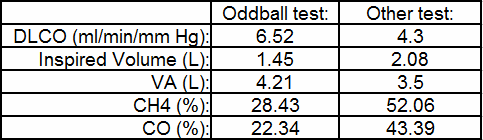
Today a patient’s report came across my desk and as usual I took a look at the raw test results. What I saw was that two out of three of the DLCO tests had been performed with the correct inspired volume but that the one with a much lower inspired volume had a much larger VA and DLCO when compared to the other results. This got me scratching my head since the patient has severe COPD and that usually means that a lower inspired volume leads to a lower DLCO and VA. When I noticed the analyzer signals during the breath-hold period that’s when I could see right away why the results had been overestimated.
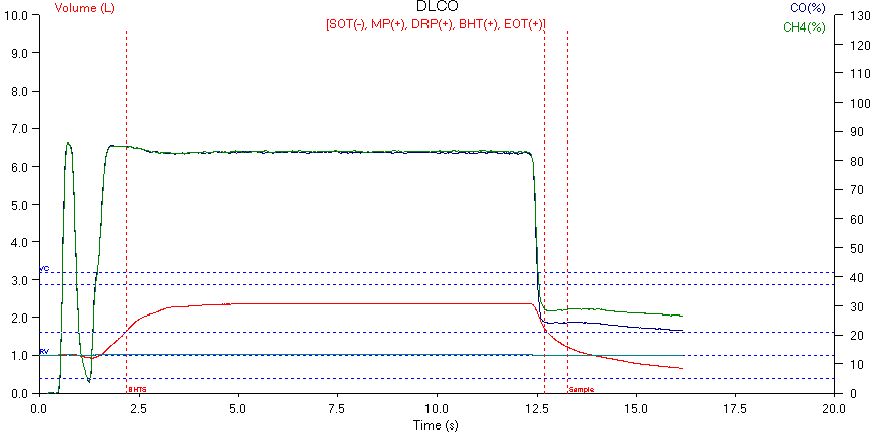
Here’s the test with the low inspired volume:
Here’s a test from the same patient with the proper inspired volume:
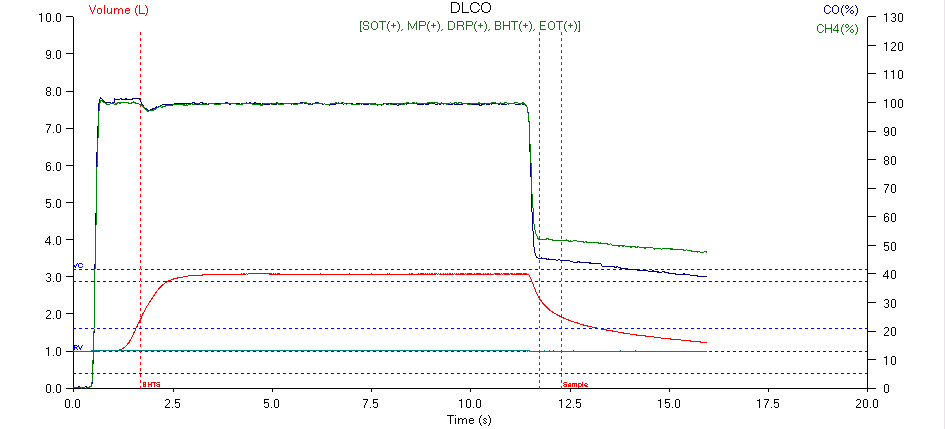
In our test systems the DLCO analyzer continues to sample the inspired gas during the breath-holding period. On the graphs this is normalized using the calibration zero offset and gain to 100% rather than to a specific concentration (it doesn’t matter what values you use because it’s the ratios of concentrations that matters not the actual concentrations). In the oddball test the inspired gases show up as being around 85% not 100%. You will also notice that in this test the exhaled CO and CH4 concentrations are significantly lower than in the other tests.
My take on this (and of course the manufacturer’s technical staff may well disagree) was that there was an abrupt decrease in the DLCO gas analyzer’s zero offset. When the zero offset decreases, even if the gain remains unchanged, the analyzer’s signal output will be reduced. This is what I think caused the inspired gas concentrations to be reduced.
Although the DLCO gas analyzer goes through a pre-test check (not a calibration), either the change in zero offset was still within specifications or the zero offset changed after the pre-test check. If the analyzer’s signal was reduced then the exhaled CH4 and CO concentrations will also be reduced. Since VA is calculated from the inspired volume and the change in CH4, despite the fact that the inspired volume was low the calculated VA is elevated. DLCO is in turn calculated from the VA and the change in CO and since the VA was elevated and the exhaled CO was reduced the DLCO is going to be higher.
The oddball test was the second of three tests. The first and the third test both had the proper inspired volume and the inspired gases were at 100% so whatever the problem was, it came and went quickly. It’s possible there was a voltage surge or dropout although I would have expected the power supply for the analyzer to handle these things. This is one of the reasons that makes this test a poor example. What it does illustrate however, is that (once again) the test with the highest results is not always the test that should be reported. It also shows the need to remain vigilant about even small details in test results.
I think that inspired volume is the most important quality indicator of DLCO tests. There is more than sufficient reason to be suspicious when a DLCO test with a low inspired volume has a higher result than a test with the proper inspired volume. Although I also tend to think that a DLCO test with a higher VA is probably more accurate than a test with a low VA in this case I think the elevated VA was due to an analyzer error and the clue to that error was the low inspired gas concentration.
This is likely a moderately unusual error at least in terms of its magnitude. It remains unclear to me just how common or uncommon this kind of problem actually is. I suspect that on a much smaller scale it is probably a common occurrence since that’s just the nature of analog electronics. It’s taken me some time but I’ve learned from our equipment manufacturer that the software for our test system uses the zero offset and gain from the last “real” calibration to calculate exhaled CH4 and CO. Even though the DLCO analyzer goes through a pre-test check, the results of check are compared to the normal operating range of the analyzer and not to the last calibration. Since the results from the pre-test analyzer check are not saved or stored in any way this means that (at least presently) it’s not possible to determine what changes in zero offset and gain routinely occur during the course of a given day.
[Warning, rant ahead!]
In a more general sense I am concerned that the details of how our pulmonary function test equipment actually gets from physical measurement to numerical results has become, if not exactly hidden, at least difficult to get at. I don’t necessarily blame the equipment manufacturers because if more people in our field asked these kinds of questions they would likely be more forthcoming with answers. Having said that I don’t think it is realized just how much of the accuracy we take for granted in the test systems we use every day is based on proprietary, and therefore opaque, hardware and software processes. I wince every time I read a research paper and see that critical results came from “test system model 123 of manufacturer X” and it is apparent the accuracy of the equipment was never questioned or verified. I would really would like to see a lot more skepticism on the part of researchers, technicians and medical directors as well as more openness from the equipment manufacturers.

PFT Blog by Richard Johnston is licensed under a Creative Commons Attribution-NonCommercial 4.0 International License.